DIGICORE's Connect to Win 2025 brought together clinicians, researchers, data scientists and technologists in Brussels for two
intensive days of collaboration on RWE and cancer care innovation. Despite national strikes, the event generated
valuable discussions and strengthened partnerships across European cancer centers.
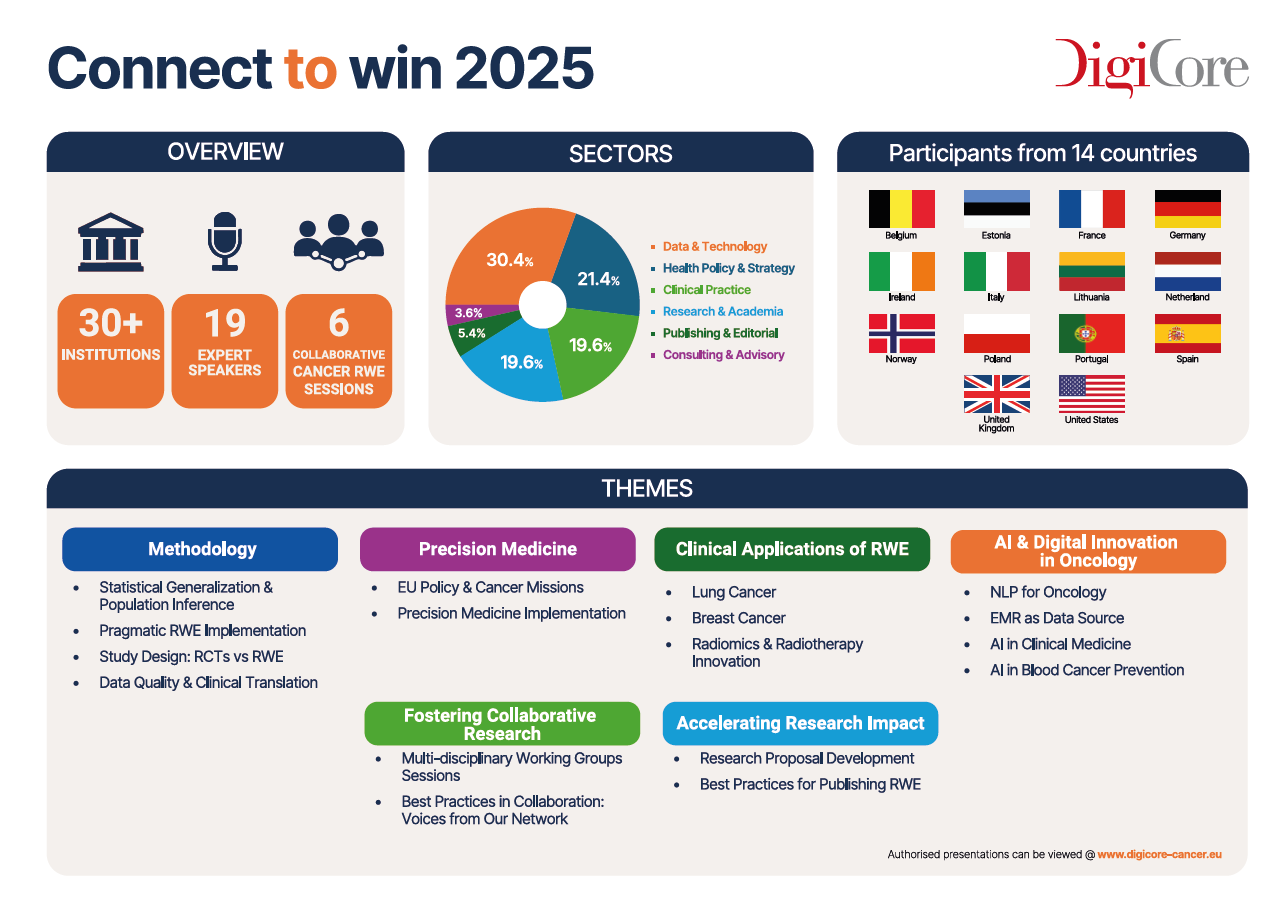
The two-day program featured six comprehensive sessions exploring RWE in precision oncology. The event opened with
foundational discussions on bridging clinical trials and real-world practice with presentations from
Prof. Julie Josse (Inra) on causal inference
approaches,
Prof. Asieh Golozar
(Nemesis Health) on data curation,
Prof. Richard Bulbulia
(University of Oxford) on integrating randomisation in RWE, and
Dr. Susan Evans
Axelsson (EAU UroEvidenceHub) showcasing the EAU UroEvidenceHub.
Session 3 focused on collaborative research development, where
Dr. Alberto
Traverso introduced DIGICORE’s Working Groups, followed by presentations from the lung, breast, and
RWE/Tech co-chairs on their ongoing research.
The second day highlighted concrete RWE applications across cancer types, featuring the DINASTY Lung Study
(presented by
Dr. Åsa Öjlert from
Oslo University Hospital), radiomics for personalised radiotherapy (presented by
Dr. Luca Boldrini from
Fondazione Policlinico Universitario Agostino Gemelli IRCCS), AI validation challenges (presented by
Prof. Dirk De Ruysscher
from Maastricht University), breast cancer RWE (presented by
Dr. Cédric van
Marcke from Cliniques universitaires Saint-Luc) and AI-driven risk stratification in hematological
conditions (presented by
Prof. Matteo Giovanni Della
Porta from Humanitas University).
The Dragon's Den session – now in its second year - saw DIGICORE Working Groups pitch protocols to editors Nature Communications
(Dr. Kathryn McGinnis), Nature Health (Dr. Lorenzo Righetto),
and ESMO Real World Data and Digital Oncology (Dr. Rodrigo Dienstmann), addressing three key research questions:
AI in multidisciplinary tumor boards, chemo-immunotherapy in triple-negative breast cancer (the CONNECTION study), and treatment
pathways for oligo-progressive metastatic non-small cell lung cancer.
The event concluded with presentations on tools and platforms advancing RWE generation, including IQVIA’s
next-generation EHR systems (presented by
Dr. Ernest Sarrias), the San
Raffaele AI Center (presented by
Prof. Carlo Tacchetti), and NLP applications in Lithuanian clinical settings
(presented by
Dr. Mindaugas Morkunas from Vilnius
University Hospital Santaros Klinikos).
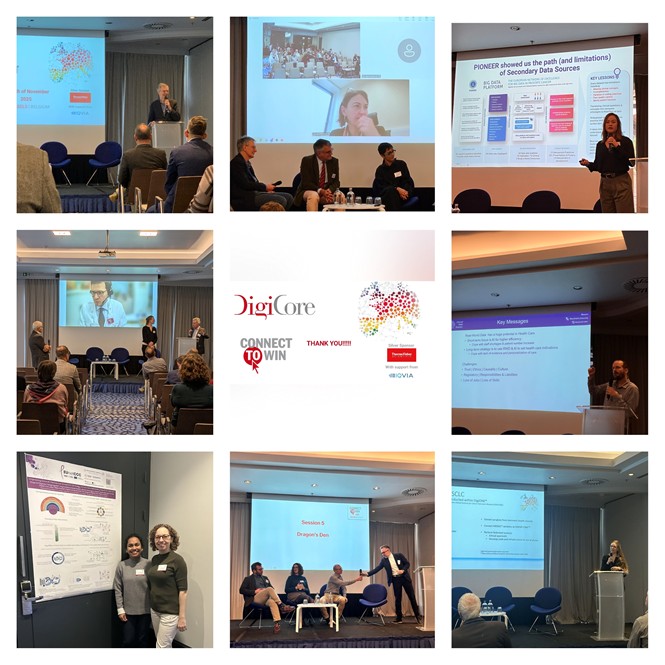
Special thanks to all speakers, journal editors, poster presenters, and participants, as well as event sponsors
Thermo Fisher Scientific and
IQVIA.